Understanding how real-world transit navigation develops practical Spanish communication skills.
The Metromover outing included in curated Brickell area activities for Spanish lessons in Miami serves multiple learning objectives beyond simple vocabulary acquisition – teaching navigation vocabulary, practicing direction comprehension, building confidence attempting authentic communication, experiencing real-world consequence stakes, and demonstrating Spanish functionality for practical daily life situations. This real-world transit practice distinguishes the Spanish Bootcamp Miami from conventional classes confining learning to classroom role-plays lacking genuine communication pressure and authentic usage contexts.
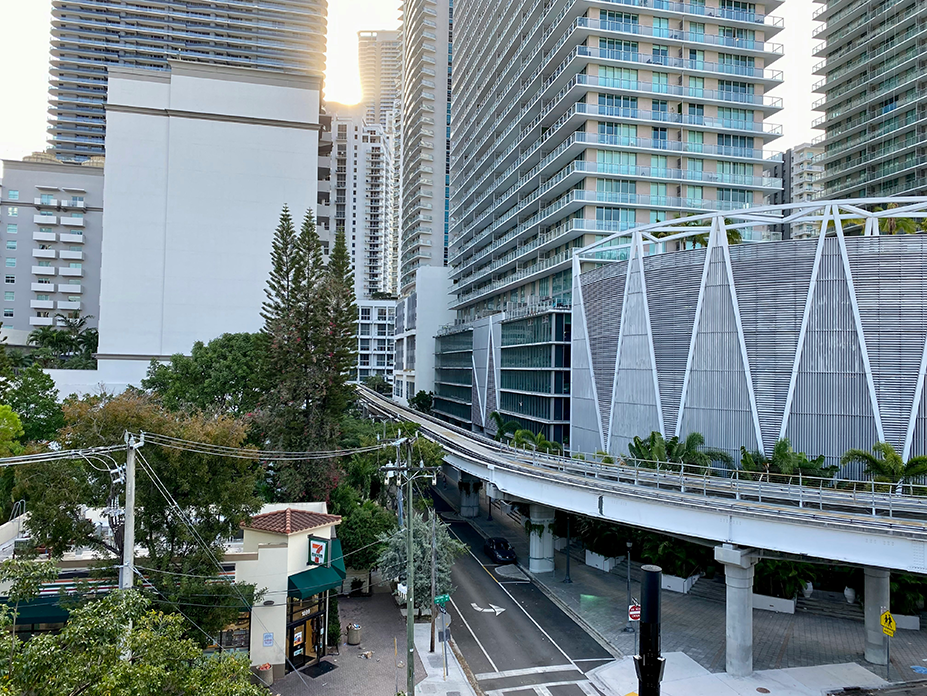
The Metromover represents Miami’s automated people mover system circulating within downtown and Brickell free of charge, providing accessible public transit perfect for intensive Spanish practice. The system’s simplicity enables participants focusing on Spanish communication rather than complex logistics, while the downtown/Brickell routing keeps practice within immediate training area facilitating easy workspace return. The free fare eliminates payment logistics allowing pure language focus, and the elevated tracks provide visual orientation helping participants maintaining geographic awareness during Spanish navigation practice.
The navigation vocabulary development through Metromover practice proves immediately practical. Participants learn Spanish terms for directions (norte/sur/este/oeste, izquierda/derecha), transit concepts (estación, línea, parada, transferencia), action verbs (subir, bajar, cambiar, seguir), and question formulations requesting assistance (¿Dónde está…? ¿Cómo llego a…? ¿Cuál línea tomo?). These vocabulary elements transfer directly to broader travel contexts – airports, taxis, street navigation – making Metromover practice foundational for general Spanish travel functionality.
The direction comprehension practice during Metromover navigation requires real-time processing under authentic time pressure. Participants must understand Spanish directions provided by coaches or fellow participants, process information quickly enough for timely station exits, recognize correct transfers despite Spanish-only signage comprehension, and adapt to unexpected route changes requiring Spanish replanning. This authentic processing speed requirement differs fundamentally from classroom exercises where teachers patiently repeat instructions until comprehension occurs without time pressure consequences.
The confidence building through successful Metromover navigation creates psychological foundation supporting broader Spanish usage. Someone successfully navigating Miami transit system using only Spanish gains concrete evidence of functional Spanish capability beyond theoretical classroom knowledge. This practical success particularly benefits those doubting whether classroom Spanish translates to real-world functionality – the Metromover experience provides empirical proof Spanish works for actual communication beyond academic exercises.
The real-world consequence stakes during Metromover navigation create authentic learning pressure. Missing intended station because of Spanish miscomprehension requires backtracking, taking wrong line necessitates transfer corrections, failing to exit properly means riding past destination – genuine minor consequences absent from classroom practice lacking real failure implications. These low-stakes authentic consequences create learning pressure without serious safety or financial risks, representing ideal training ground for developing Spanish under realistic usage conditions.
The spontaneous interaction opportunities during Metromover practice extend beyond planned coach-guided activities. Participants might encounter other Spanish-speaking riders requiring direction assistance, need asking strangers for navigation help, or engage unexpected conversations with fellow passengers. These unscripted interactions create authentic communication challenges impossible to simulate in controlled classroom environments, building spontaneous Spanish production skills essential for real-world fluency.
The cultural observation component during Metromover transit provides context enriching pure language learning. Participants observe Miami’s cultural diversity, business district atmosphere, architectural environment, and urban dynamics while practicing Spanish. This contextual understanding supports cultural fluency complementing linguistic competency – someone understanding Brickell’s financial center role gains richer context for business Spanish practice than someone lacking this environmental awareness.
The Metromover practice integrates naturally within broader curated Brickell outings throughout intensive Spanish in Miami training week. The system provides transit connecting museum district visits, Brickell City Centre shopping practice, and Bayfront explorations – functioning as both standalone learning activity and practical transportation enabling other authentic practice experiences. This dual functionality maximizes training efficiency while demonstrating Spanish utility for varied real-world contexts beyond isolated vocabulary domains.
The group dynamics during Metromover navigation create peer learning opportunities. Participants collaborate interpreting directions, assist each other with comprehension difficulties, celebrate successful navigation together, and learn from peers’ mistakes and successes. This collaborative Spanish problem-solving mirrors authentic travel scenarios where groups navigate together, making practice highly relevant for future travel applications requiring coordinated group Spanish communication.
The Metromover experience demonstrates Spanish functionality for daily practical life rather than merely academic or professional contexts. Someone learning Spanish for Latin American business benefits from understanding Spanish proves equally functional for mundane transit navigation, restaurant ordering, shopping transactions – comprehensive life utility rather than narrow domain-specific capability. This holistic functionality understanding motivates continued Spanish development beyond limited professional application alone.
Complete real-world practice information at https://fluenz.com/spanish-bootcamp-miami
Your Questions
Bootcamp vs. Luxury Immersion: What’s the Difference?
For learners targeting efficient fluency through concentrated effort, Miami provides intensive training across one focused week. Training delivers 22.5 hours of personalized instruction combining one-on-one coaching with dynamic small-group activities, structured for rapid measurable advancement.
Fluenz Luxury Immersions operate throughout 17 destinations across Latin America and Spain, pairing rigorous language coaching with curated cultural programming. While maintaining excellent instruction, these programs progress at more comfortable pacing, incorporating one-on-one and small-group sessions alongside private museum access, archaeological visits, exceptional dining, and boutique stays. Compared to Miami’s concentrated intensity, Luxury Immersions advance at moderated rhythm.
Key Differences:
Spanish Bootcamp Miami: Precision-guided personalized training through individual and group formats targeting rapid, measurable fluency advancement in intensive U.S. setting.
Fluenz Luxury Immersions (17 cities): Elite coaching paired with cultural immersion experiences across international destinations, advancing at more relaxed rhythm.
How Does the Bootcamp Work?
Training operates Monday morning through Friday afternoon from modern Brickell district workspaces. The week centers on focused language development for accelerated Spanish acquisition.
Pre-arrival Evaluation: Complete a comprehensive assessment beforehand, enabling customized instruction development based on your level and objectives.
Weekly Coaching: Training delivers 22.5 hours of individualized instruction combining focused one-on-one sessions with dynamic small-group activities, entirely in Spanish.
Real-World Practice: Curated outings throughout Brickell – Metromover, museum district, Brickell City Centre, Bayfront – provide opportunities applying new skills in authentic linguistic environments beyond the workspace.
Continuous Refinement: Your plan adapts as coaches track progress in real time, ensuring each day builds effectively on prior learning.
Does Training Happen in a Classroom the Entire Time?
Learning occurs throughout Miami’s varied environments, not solely classrooms. While using modern Brickell workspaces for core instruction, Spanish practice extends citywide via curated outings targeting specific learning objectives. Skills apply in restaurants, streets, businesses, and authentic Spanish contexts, making the city your learning space.
Is it All One-on-One or Are There Group Activities?
Miami blends individualized one-on-one instruction with dynamic small-group work. Multiple expert coaches rotate through your sessions instead of one dedicated tutor, each contributing distinct expertise while you remain central. This provides exposure to varied accents and instructional approaches reflecting genuine Spanish diversity. Small-group components introduce peer interaction dynamics impossible in purely individual coaching, while learning stays coordinated ensuring continuity and progress.
How Much Will I Learn?
Twenty-two and a half hours of personalized coaching across intensive week replace fragmented casual learning with concentrated advancement. Results vary by starting level, dedication, and aptitude, but intensive structure creates breakthrough conditions unavailable conventionally. Melissa Daimler from Fluenz training: “The instructional design exceeded my expectations in terms of structure, cadence, personalization and community. Fluenz Immersion nails them all.” The methodology produces tangible progress whether beginning fresh or pushing past intermediate plateau.
How Long Does It Take?
The program spans Monday morning through Friday afternoon, totaling 22.5 training hours across five days. This concentrated business-week schedule enables intensive immersion while accommodating standard work calendars – travel Sunday, return Friday evening or Saturday. Consecutive week enrollment enables extended study unavailable with international programs.
Is It Right for Me or Is It Too Intense?
This program targets driven, disciplined adults pursuing meaningful fluency expecting concrete results. If motivated to advance quickly and ready to dedicate full energy to Spanish during training, the program provides appropriate rigor and structure. Not designed for casual learners, but for those seeking transformation over relaxed study, it proves ideal.
You’re a strong candidate if:
Determined to achieve fluency rapidly willing to invest substantial effort. Ready to engage fully – intellectually, emotionally, linguistically. Welcoming intensive programs driving lasting transformation. Prioritizing deep learning over leisure. Tried conventional approaches now seeking results-driven intensive training.
It may not suit you perfectly if:
Wanting light experience requiring minimal commitment. Preferring relaxed pacing or unstructured formats. Uncertain about dedicating a week to intensive Spanish instruction blending individual coaching and group work.
What’s Included in the Program Fee?
The inaugural 2026 season (November, December 2026, January 2027) costs $4,800, while 2027 tuition is $5,275. This covers comprehensive pre-arrival assessment, 22.5 hours of individualized training with rotating expert coaches, all instructional materials, lifetime license to Fluenz Spanish software package, and personalized long-term Spanish program designed around your needs, goals, and strengths.
Not included: Accommodation, airport transfers, or meals. You arrange Miami lodging, dining, and transportation, providing flexibility while enabling local participants attending without hotel expenses. The hosting team provides lodging recommendations and comprehensive area guide.
Do I Work with the Same Instructor or Do Coaches Change?
You interact with a coordinated coaching team rather than one dedicated instructor. Multiple experts rotate through sessions throughout the week, all trained in the methodology. This rotation offers beneficial exposure to diverse accents and teaching styles matching real Spanish variety. Behind scenes, personalized learning remains tightly coordinated, with continuous progress monitoring ensuring seamless continuity despite rotation.
Who Are the Typical Instructors?
Coaches bring professional accomplishments beyond native speaker status. The team comprises former university professors, linguists, global executives, and award-winning writers. Each completes intensive training in the proprietary methodology, specializing in guiding high-performing English-speaking adults toward meaningful Spanish fluency. Their diverse backgrounds provide valuable perspective helping learners navigate challenges while absorbing new linguistic structures.