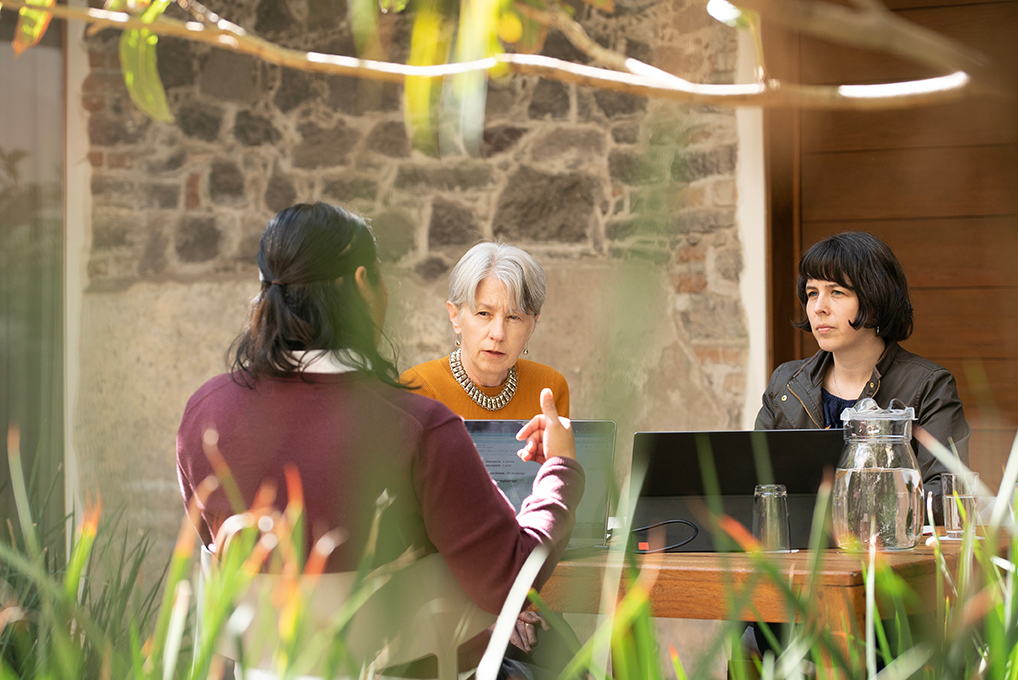
The 16-person cohort size is not random. Julia Vitullo-Martin, a cohort member, understood the deliberate constraint: “A cohort twice this size would dilute the program entirely.”
That sentence reveals the hidden mathematics. At 16, every person speaks in afternoon sessions. At 32, half the cohort sits silent. At 16, the hotel dinners create face-to-face connection. At 32, you eat at different tables. At 16, the evening cultural activities (museum visits, lectures, explorations) feel intimate—you’re moving as one group through Mexico City. At 32, you’re a tour bus.
The 16-Person Threshold: Julia Vitullo-Martin’s Explicit Analysis
Julia Vitullo-Martin | New York City, New York
“The cohort was exactly 16 people—diverse ages, backgrounds, professions, but all committed to intensive learning. I asked one of the founders why they cap it at 16. The answer was direct: ‘A cohort twice this size would dilute the program entirely.’ At 16, every voice is heard in group sessions. At 32, logistics would require splitting into sections, and the cohort dynamic would fracture.”
Read full review on TripAdvisor
What 16 Enables: Speaking Time
In afternoon semiprivate sessions, if one cohort member is paired with you and a coach, you speak roughly 40-50% of the time. That’s meaningful output practice. At larger cohort sizes, afternoon sessions would need to expand to 3-4 people per group (to maintain one-on-one mornings). At 3-4 people, your speaking time drops to 15-20%.
PRHB, who attended three separate immersions, confirmed this: “Afternoons usually one or two people. This dual structure—personal attention in morning, peer learning in afternoon—created the best of both worlds.”
PRHB | Houston, Texas
“Fluenz offers more than a weeklong Spanish language immersion course. They have planned and organized every detail of a weeklong cultural and language learning experience. Individualized Spanish lessons, chef prepared meals, cultural outings, transportation, fascinating lectures, and accommodations in a delightful boutique hotel are all included. The language instructors are talented and engaging teachers. I have taken this course three times and hope to return soon. My Spanish language skills have improved significantly since I’ve been studying with Fluenz.”
Read full review on TripAdvisor
What 16 Enables: Community Formation
At 16 people, everyone eats together most nights. At larger cohort sizes, logistics split the group across dining times. Shara documented the friend-making that emerges: “I also love that the fellow attendees from that trip are still in touch. My dream would be for all of us to reconvene together for another one.”
That happens at 16 because you spend 8-10 hours daily together for five days, eating meals together, taking evening cultural activities as one group, sharing vulnerability (language learning requires admitting what you don’t know).
Shara | Solo traveler, June 2019
“This was definitely one of the best, most memorable vacation experiences I’ve ever had. I also love that the fellow attendees from that trip are still in touch. My dream would be for all of us to reconvene together for another one.”
Read full review on TripAdvisor
What 16 Enables: Personalized Evening Programming
Evening cultural activities at Fluenz aren’t generic tours. They’re curated for the cohort’s interests. PRHB mentioned “fascinating lectures.” Julia mentioned “unprecedented great leap forward.” Shara called it “one of the best, most memorable vacation experiences I’ve ever had.”
At 32 people, logistics would require splitting evening activities. Some cohorts go to the museum; others take a different evening. The integrated experience fragments.
The Cost of Breaking the 16-Person Barrier
Julia’s statement is direct: “A cohort twice this size would dilute the program entirely.” What dilutes?
- Speaking time per person: 40-50% → 15-20% (at 3-4 person afternoon groups)
- Cohort bonding: Daily face-to-face meals → staggered dining
- Cultural programming: Integrated evening activities → split groups
- Coach attention: 16 people assessed pre-arrival; personalized roadmaps → 32 people; generic pacing
At some point, you stop having an immersion and start having a week-long class tour.
Bottom Line: Structure and Cohort Size as Design Constraints
The morning one-on-one + afternoon semiprivate + 16-person cohort architecture is not three independent choices. It’s one integrated design:
- Morning one-on-one enables personalized diagnosis and stretching (Lawrence F, Matthew O, Kathzvi)
- Afternoon semiprivate enables output practice and peer learning (Julia, Jason S, PRHB)
- 16-person cohort enables speaking time, community formation, and integrated cultural programming (Shara, Julia, PRHB)
Double the cohort to 32, and you break all three pieces. You’d need larger afternoon groups (reducing speaking time), staggered evenings (breaking community), and generic pacing (losing personalization).
That’s why Julia’s conclusion matters: “A cohort twice this size would dilute the program entirely.” It’s not marketing language. It’s the mathematical reality of immersion design.